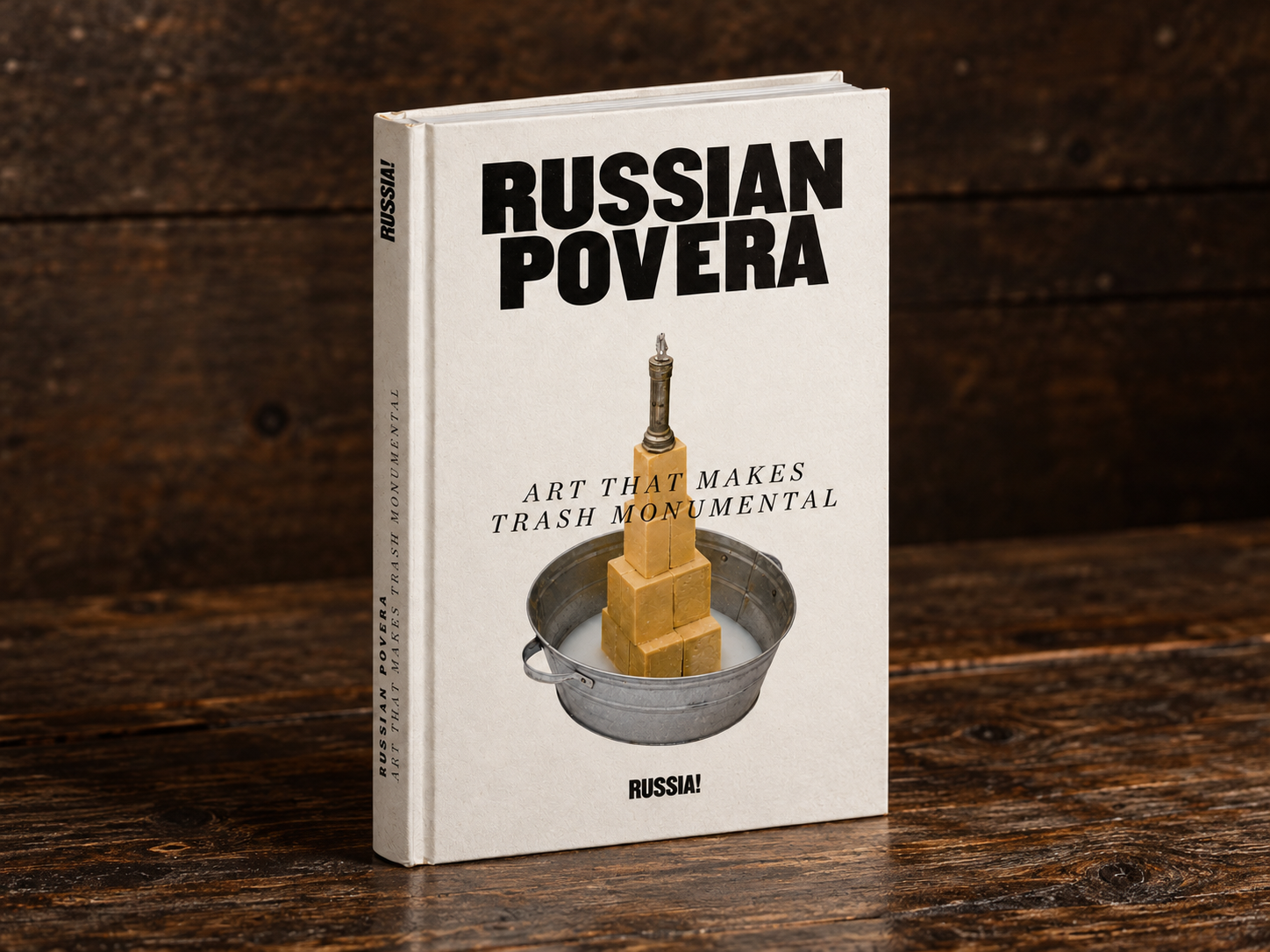
Russian Povera: Art That Makes Trash Monumental is a book I produced with a preface and writing by Alexander Nazaryan, published by Russia! Books in 2010. It was made under the guidance of Marat Guelman and documents his Russian Povera exhibition, the show that opened the Perm cultural project in 2008.
The project itself was an unusual experiment: Perm, a closed military-industrial city in the Urals, decided to reinvent itself through contemporary art. Guelman turned the Stalin-era river station into the PERMM museum, and the governor’s ambition was for Perm to become a European capital of culture.
Russian Povera was the first of those shows and, by attendance and press, one of the most successful contemporary art exhibitions in 21st-century Russia. The concept borrowed its name from Italian Arte Povera, the post-war, post-fascist movement that worked with poor materials — but Guelman’s version was post-Soviet. The artists (Leonid Sokov, Haim Sokol and others) make work out of trash, scrap and found objects: a tower of soap bars in a tin washtub, a dollar sign cut from rusted metal, a Suprematist composition assembled from bread and sausage. The point was not scarcity for its own sake. It was that a country that had lived through totalitarianism and then collapse had developed its own language for making the discarded monumental, and that language deserved to be taken seriously as a movement rather than a quirk.
The book collects the works from that first exhibition, with Nazaryan’s framing of what Russian Poor Art is and, more usefully, what it isn’t: not the art of oligarch collections, not Fabergé, not the official story. It remains, as far as I know, the only English-language record of the show.
Book was designed by Dima Barbanel.